 Jules Belveze
The Case for Small Specialized Models
One hot idea of 2026 is the “System-1” decision model: a small, non-autoregressive model that classifies without generating text and returns calibrated probabilities in a single forward pass. TypeSafe AI’s Jev introduced it with crazy numbers (~193× faster, ~445× cheaper than an LLM), Together shipped an open clone, Tev1-4B (the “$17” post), and the community followed with laya, von, and others.
Those speed and cost claims are measured against frontier LLMs, and are extremely competitive again them. But reading the launch posts, I realized I had no fresh numbers for the tool I default to: fine-tuned tiny encoders. The literature says fine-tuned small models still beat zero-shot generative models on text classification, and the common production pattern is (hopefully) a cheap classifier that routes traffic and escalates only the hard cases to an LLM.
So I measured both sides myself: a dataset of my own, Modal GPUs, the 4B model running locally, and the original Jev through TypeSafe’s API. One thing to get out of the way first: a model trained on in-domain labels should beat a zero-shot one. What I wanted to know was what whether small models are still a thing in 2026, and how many labels it needs before it pays off. The answers: a 29 macro-F1 point lead over the best decision model, for about 100 labels, an hour of annotation. However, an check on AG News showed me where the decision models genuinely shine.
A Taxonomy of My Own
tldr_news is ~22k items from the TLDR newsletters, each carrying a section
label. The raw labels are messy (23 near-duplicate sections, an empty label, sponsor
rows), so I collapsed them into clean classes. The
per-class diagnostic below shows what that does. Tev collapses to 0.00 on it and laya to
0.25, while the fine-tuned models score around 0.9, because they learn the format from
length cues alone. A zero-shot model has no way to guess a newsletter’s editorial
conventions, so I dropped the class and ran the comparison on the five content classes.
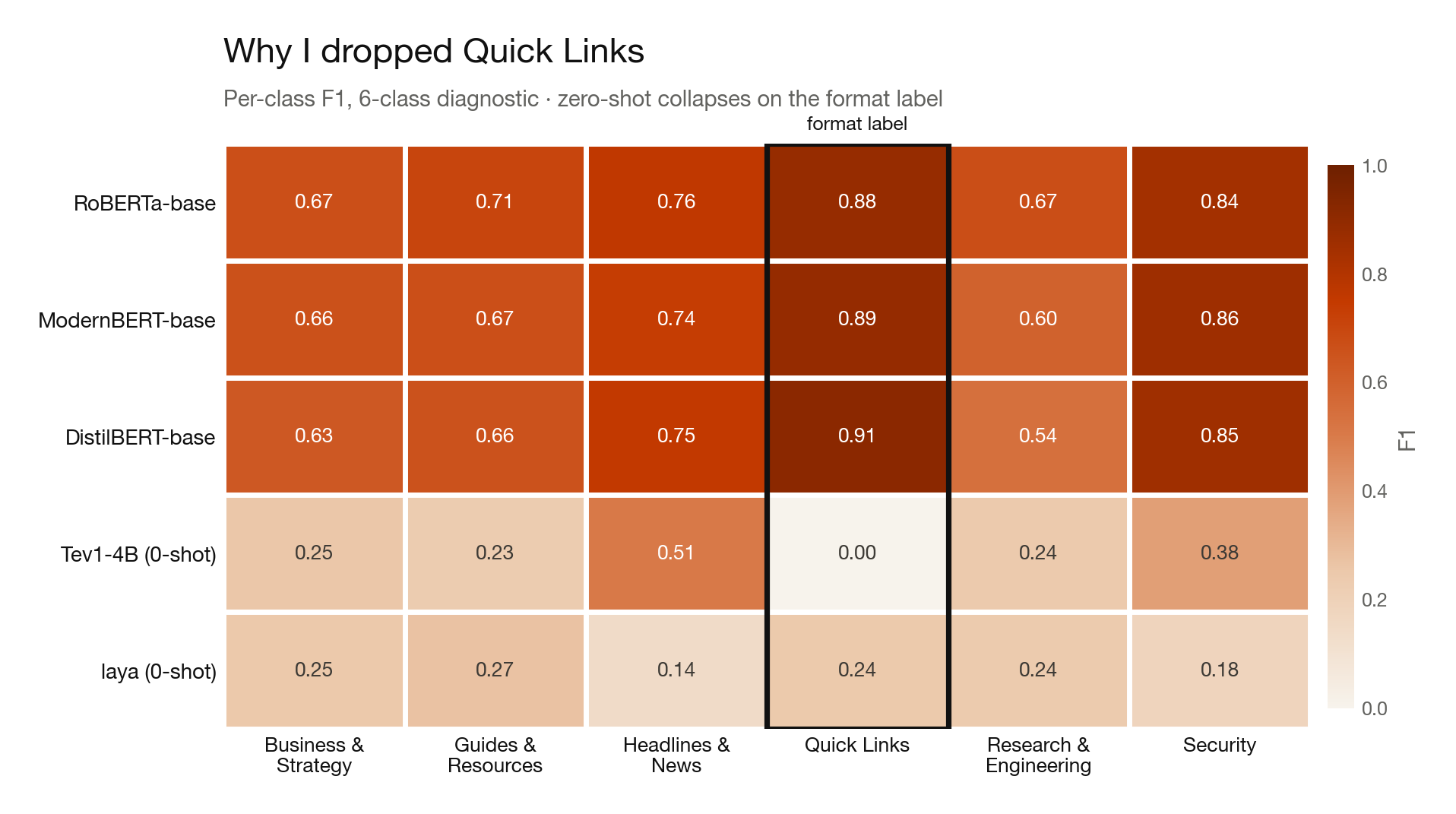
The zero-shot models also grab at Security whenever they’re unsure: on the six-class run, Tev recalls 0.98 of Security items with 0.24 precision.
Full disclosure, so you can discount accordingly: this is my dataset, my label mapping, and my class descriptions. All numbers below share the same seed-42 stratified split (~1.2k test items), body-only input, macro-F1.
Thirty Points Apart
| Model | Approach | Params | macro-F1 | ms/item (bs=1) | ms/item (bs=32) |
|---|---|---|---|---|---|
| RoBERTa-base | fine-tuned | 125M | 0.783 | 10.5 | 7.1 |
| ModernBERT-base | fine-tuned | 150M | 0.759 | 16.5 | 9.7 |
| DistilBERT-base | fine-tuned | 67M | 0.739 | 5.4 | 3.6 |
| FastBERT | early-exit | 251M | 0.732 | 11.8 | 8.4 |
| TheseusBERT | compression | 151M | 0.709 | 4.6 | 3.6 |
| Clef | zero-shot decision model | 27B | 0.419 | 341.2 ⁴ | 102.5 ⁴ |
| Tev1-4B | zero-shot decision model | 5B ¹ | 0.410 | 418.9 | 123.4 |
| Jev (API) | zero-shot decision model | undisclosed | 0.407 | n/a ² | n/a ² |
| laya | zero-shot decision model | 421M | 0.381 | 59.9 | n/a ³ |
¹ Named 4B; the checkpoint reports ≈5B parameters on its model card.
² Jev runs behind TypeSafe’s API (p50 round trip ~250 ms); not comparable to local
single-GPU numbers, so it sits out the latency and cost columns.
³ laya’s Router.predict has no batch API, so it runs single-item.
⁴ Clef (27B) doesn’t fit the L4 used for the other rows; its latency and cost come from
an H100 at $0.001097 per GPU-second.
The gap is not subtle. The worst fine-tuned model here, TheseusBERT at 0.709, beats the best zero-shot decision model, Cloudflare’s 27B Clef at 0.419, by 29 macro-F1 points. Against Tev1-4B, the zero-shot model that fits the same L4 harness, it also answers 34-91× faster. The original Jev, queried through TypeSafe’s API with the same prompts, lands at 0.407, tied with its open clone. Batching helps everyone (encoder per-item latency drops 25-40%), but the ranking doesn’t move, and Tev stays 13-34× slower even batched. FastBERT and TheseusBERT are the compression architectures from my early-exiting series, trained here with bert-squeeze.
Latency converts directly into money. Batched on a Modal L4 at $0.000222 per GPU-second (Clef on its H100):
| Model | ~$ / 1M classifications |
|---|---|
| DistilBERT-base / TheseusBERT | ~$0.80 |
| RoBERTa-base | ~$1.58 |
| FastBERT | ~$1.86 |
| ModernBERT-base | ~$2.15 |
| laya | ~$13 (single-item; a batch API would cut this substantially) |
| Tev1-4B | ~$27 |
| Clef | ~$113 (batched on an H100) |
Plot accuracy against that cost:
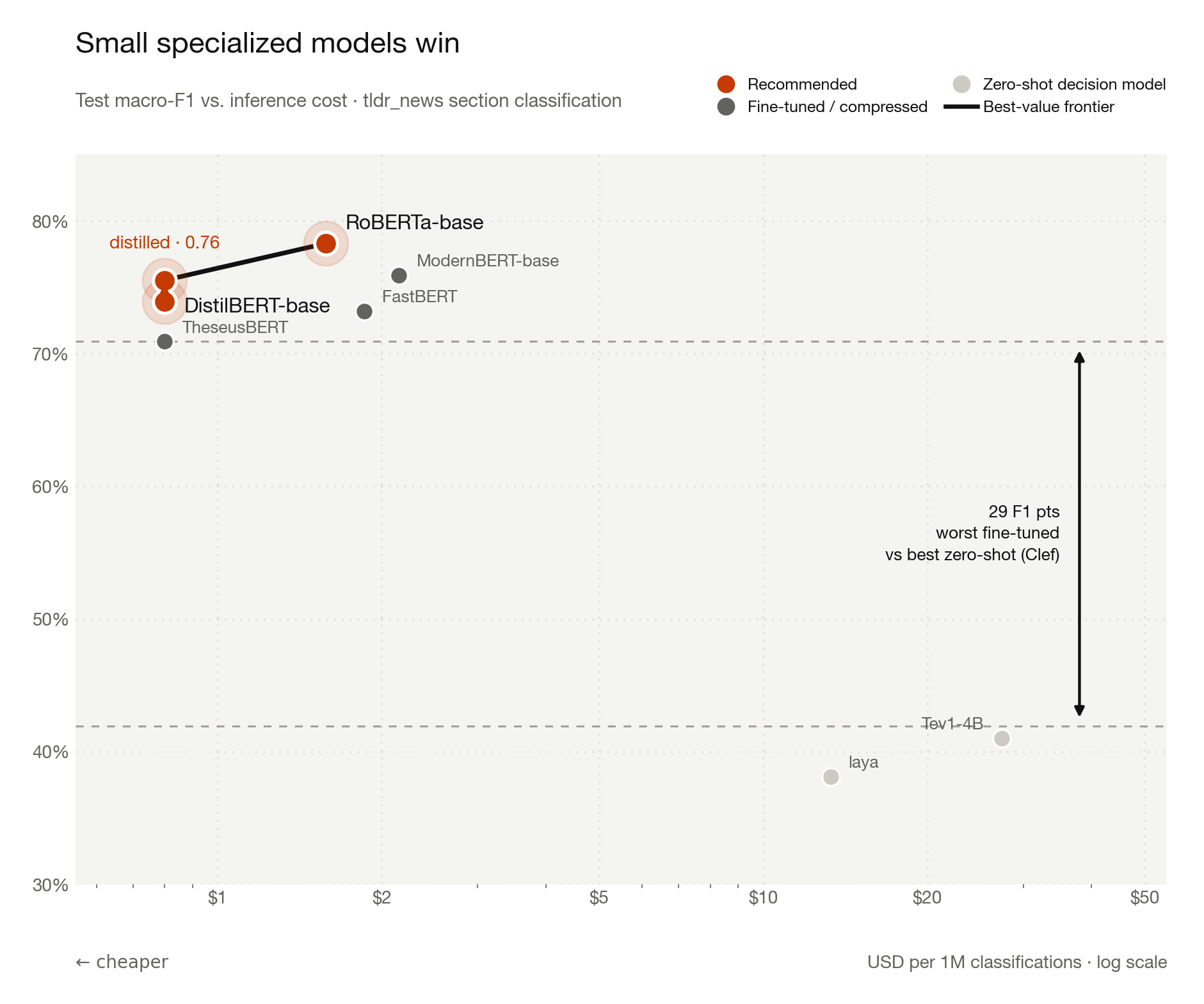
The purple arrow is a bonus: distilling a RoBERTa-large teacher into DistilBERT lifts it from 0.73 to 0.76 at unchanged size, latency, and cost.
Getting the Most Out of Zero-Shot
A comparison like this is only fair if the zero-shot side is set up carefully. I improved it step by step:
- Six classes, terse prompts: laya 0.22, Tev 0.27.
- Five content classes, richer descriptions: laya 0.38, Tev 0.41.
- Title added to the input: laya 0.38 (no change), Tev 0.42.
- Few-shot (10 exemplars) for Tev: 0.06. A caveat rather than a gotcha: few-shot is outside Tev’s documented single-shot format, so the collapse is unsurprising. The practical point stands, though. Unlike an LLM, you can’t buy accuracy with exemplars. You use these models exactly as trained, or you fine-tune them.
The best zero-shot result, Clef at 0.419, still trails every fine-tuned model by roughly 29 points.
The Calibration Test
Calibrated probabilities are the decision models’ signature claim, so I measured: ECE, Brier, NLL, and reliability diagrams, with one-parameter temperature scaling for the encoders.
| Model | acc | ECE ↓ | Brier ↓ | NLL ↓ |
|---|---|---|---|---|
| RoBERTa-base | 0.78 | 0.096 → 0.028 (temp-scaled) | 0.333 | 0.640 |
| DistilBERT-base | 0.72 | 0.126 → 0.046 | 0.418 | 0.800 |
| laya | 0.36 | 0.033 | 0.752 | 1.501 |
| Tev1-4B | 0.41 | 0.327 | 0.860 | 1.969 |
| Jev (API) | 0.40 | 0.472 | 1.028 | 6.910 |
| Clef | 0.45 | 0.323 | 0.812 | 1.658 |
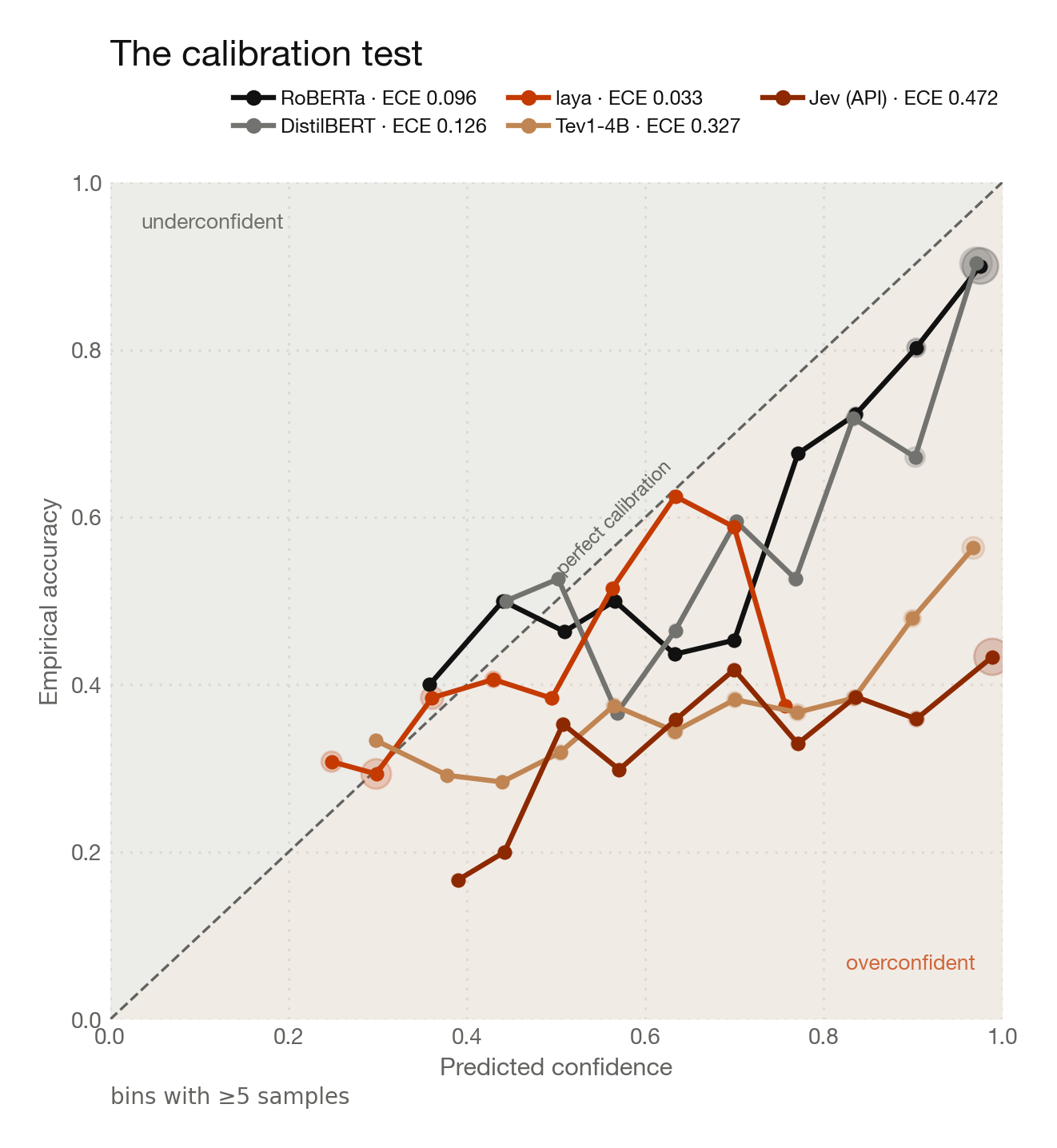
Giving them a fair comparison: laya honors its ECE claim. An expected calibration error of 0.033 is genuinely good. But it’s the calibration of a flat, underconfident distribution. The model is unsure and mostly wrong, which is why its Brier and NLL are the worst in the table. Tev’s probabilities: ECE 0.327, systematically overconfident, reliability curve well below the diagonal. And a temperature-scaled RoBERTa ties laya on ECE at twice the accuracy (Brier 0.33 vs 0.75).
The original Jev is the sharpest version of this story. On AG News, where it is comfortable, its probabilities are honest (ECE 0.076). On my taxonomy it returns near-one-hot distributions while being wrong most of the time: ECE 0.472, NLL 6.9. Calibration, it turns out, is as in-distribution as accuracy. Clef is the strongest witness: Cloudflare trains it with an explicit Brier objective, and in-distribution it shows, with the best calibration in this whole post (ECE 0.026 on AG News, better than the raw encoders). On my taxonomy that same model runs overconfident at ECE 0.323, its reliability curve sitting right alongside Tev’s in the chart above.
Two caveats. Temperature scaling itself consumes the labeled validation set: cheap, but not zero labels. And at ~1.2k test items, ECE differences under ~0.02 sit inside binning noise, so read 0.028 vs 0.033 as a tie. The robust signal is Brier and NLL, and there it isn’t close.
Pricing the “No Labels” Promise
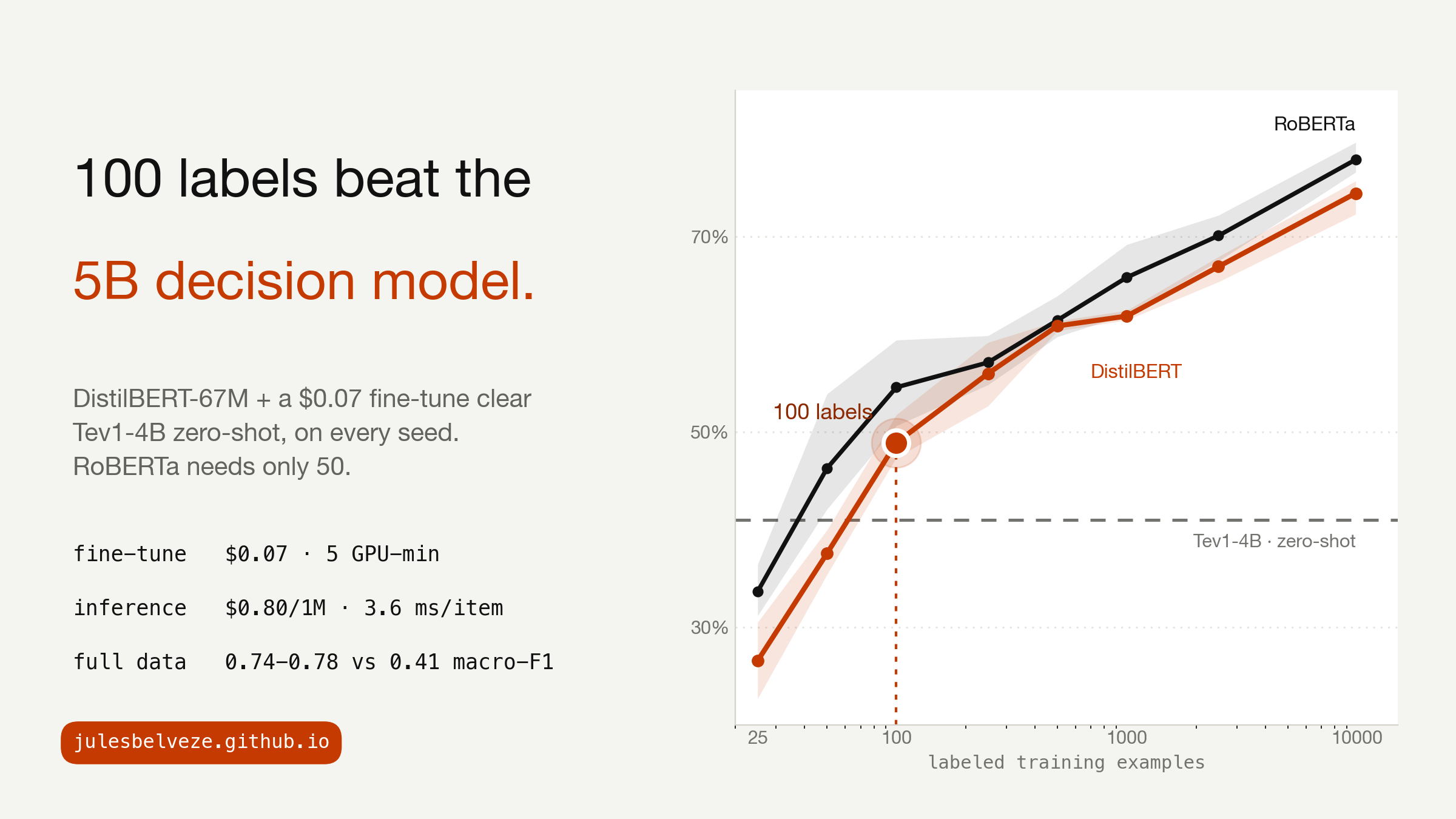
The strongest practical argument for zero-shot is skipping annotation entirely. So let’s price that convenience: fine-tune DistilBERT and RoBERTa on stratified subsamples of the training set, three seeds each, and see where they cross the zero-shot lines.
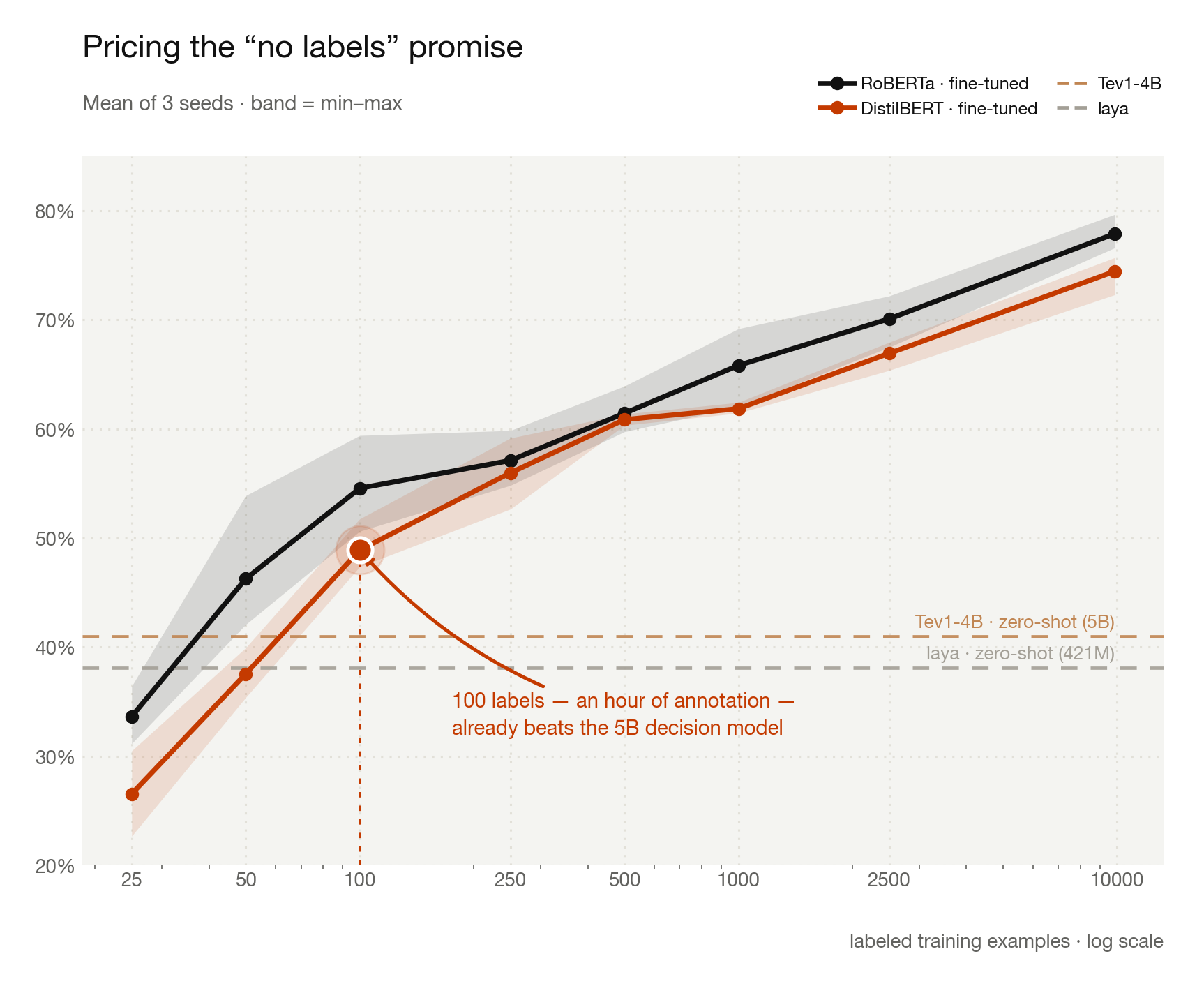
Twenty-five labels isn’t enough. DistilBERT sits at 0.27, below every zero-shot model. Fifty ties laya, and RoBERTa already noses past Tev and Clef on every seed there. At one hundred labels, even DistilBERT beats the 27B Clef on every seed (0.49 vs 0.42), and from there both curves just climb: RoBERTa hits 0.55 at 100, 0.66 at 1,000, and 0.78 on the full ~9,850.
A hundred labeled examples is an hour of annotation. The training bill is a rounding error: the full fine-tune takes about five GPU-minutes, roughly $0.07 on a Modal L4, about what it costs to classify 2,500 items once with Tev. On this taxonomy, skipping annotation costs about 30 F1 points, and an hour of labeling buys them back.
A Dataset That Isn’t Mine: AG News
Everything above is one dataset: mine, with my label mapping. So I reran the core comparison on AG News: four classes, official 120k/7.6k splits, nobody’s taxonomy but the benchmark’s own.
| AG News (official test, macro-F1) | |
|---|---|
| DistilBERT · fine-tuned (full train) | 0.944 |
| RoBERTa · fine-tuned (full train) | 0.944 |
| laya · zero-shot | 0.929 |
| Clef · zero-shot | 0.904 |
| Tev1-4B · zero-shot | 0.896 |
| Jev · zero-shot (API) | 0.884 |
| DistilBERT · fine-tuned on 100 labels | 0.851 |
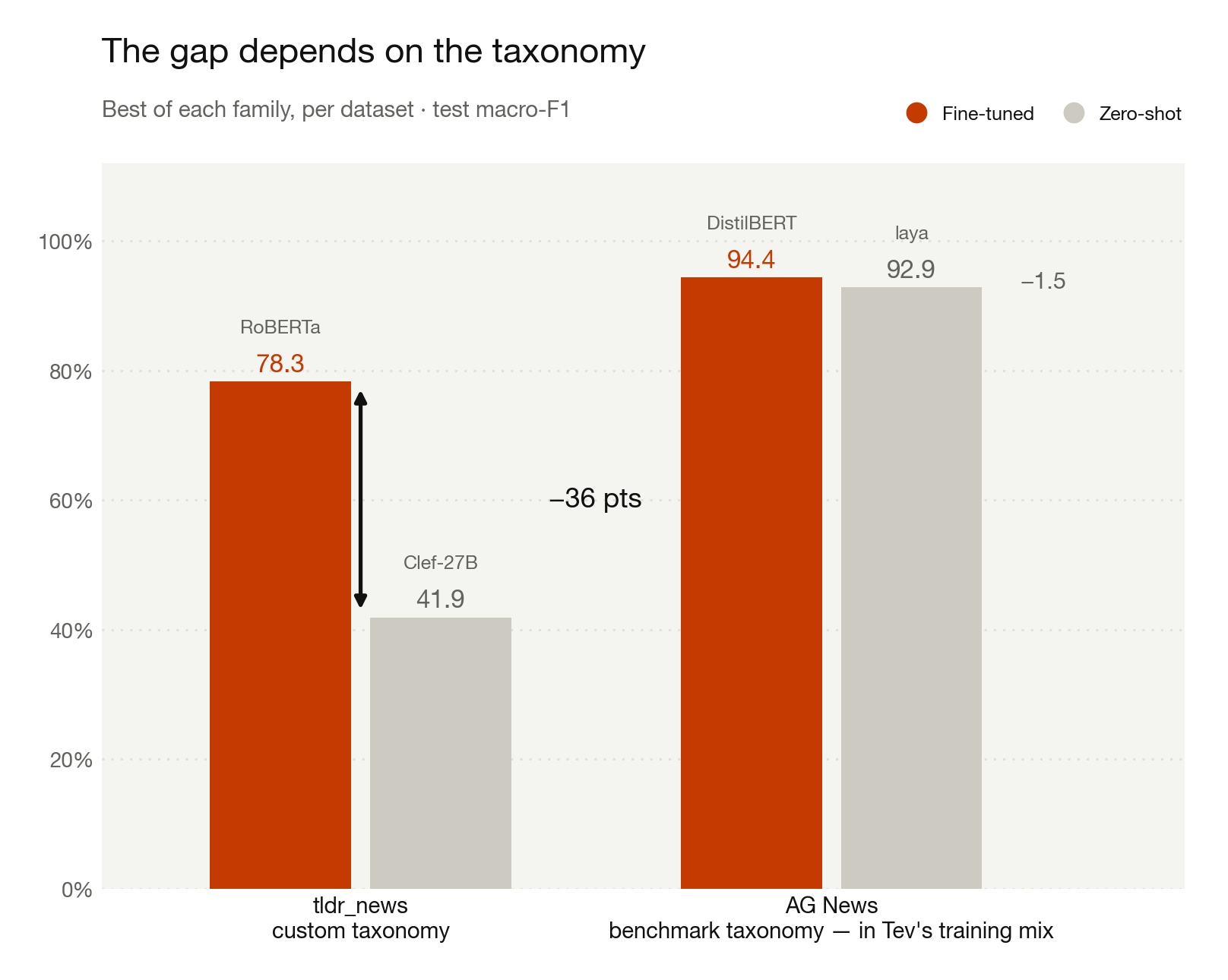
This partially cuts against my headline, and I’m reporting it anyway: on a canonical benchmark taxonomy the zero-shot decision models are good. laya lands within 1.6 points of a full fine-tune, and here zero-shot beats 100 labels.
But there’s a reason - AG News is in Tev’s training mixture. Together’s own recipe lists “AG News (1,500 examples)” among tev1’s training data (their blog). For Tev, this is closer to an in-distribution test than a zero-shot one. laya’s training mixture is unpublished, but news-topic classification is a standard decision-model demo, and its performance pattern points the same way.
Where Each Approach Fits
The picture I ended up with is more useful than the one I started with. Decision models are strong where the label schema resembles their training distribution: “zero-shot” in practice means “in-distribution for someone else’s training mixture.” If your label schema looks like a public benchmark, or if it genuinely changes at runtime, a decision model will serve you well. If your taxonomy is your own (editorial sections, internal ticket categories: the normal production case), a hundred labels plus a $0.07 fine-tune gets you a small model that leads on accuracy, latency, cost, and, after one temperature parameter, calibration too.
Even on tasks built for decision models, the small model holds up. On AG News, fine-tuned DistilBERT beats Laya 0.944 to 0.929, with a fraction of the latency and cost. And this is not just a quirk of the open clones: the original Jev scores 0.407 on my taxonomy and 0.884 on AG News, and Cloudflare’s Clef, the biggest and best of them at 27B, follows the same curve at 0.419 and 0.904. The same result shows up across price points. System-1 really is faster when the alternative is a frontier LLM. Against a small fine-tuned encoder, though, the cost advantage disappears.
Reproducing the Numbers
from bert_squeeze.assistants import TrainAssistant
TrainAssistant(
    "automodel",
    general_kwargs={"labels": list(range(5)), "num_labels": 5},
    model_kwargs={"pretrained_model": "roberta-base"},  # or ModernBERT, DeBERTa, …
    data_kwargs={"dataset_config": {
        "path": "JulesBelveze/tldr_news", "text_col": "text",
        "label_col": "section", "label_map": SECTION_MAP,  # 5 content classes
        "stratify_by_column": "section"}},
)
Runs on Modal (T4/L4/H100) - methodology:
- Training recipe: every headline fine-tune is bert-squeeze’s
TrainAssistantwith cross-entropy, AdamW at 2e-5, batch 32, max length 256, 3 epochs. The label-efficiency subsamples use a plain HF loop (AdamW at 3e-5, ~300 steps regardless of n); AG News full-data runs train 2 epochs. Encoders and Tev ran on transformers 4.57, FastBERT and TheseusBERT on 4.45 (their custom BERT graphs predate the 4.48 attention refactor), laya through itslayapip package. - Latency is a warmed-up forward pass, seq 256, ms/item, all measured on the same
L4. Tev ran locally in bf16 via HF
generate(greedy, max 8 new tokens, chat template per its model card). That’s a naive loop, not an optimized serving stack, so treat its numbers as an upper bound. laya is timed end to end through itsRouter.predictAPI, the only interface it exposes. ModernBERT is attention-kernel sensitive (roughly 2× faster with flash-attn than eager). - Variance: the headline encoder numbers are single-seed. The label-efficiency runs put seed spread at ±0.01-0.02, enough to reorder adjacent encoders and nowhere near the 30-point encoder-vs-zero-shot gap. Across experiments, DistilBERT’s full-data runs landed 0.73-0.74 and RoBERTa’s 0.77-0.80, which brackets the headline 0.783.
- The encoder eval drops a partial final batch (1,216 vs 1,232 test items, ~1%).
- The AG News check uses the official train/test splits, full test set (7,600 items, 0 unparsed answers from any zero-shot model), and the same prompting protocol as the main runs.
- Clef ran locally from its open weights (
Cloudflare/clef, Apache 2.0) on an H100 via the bundledjoint_schema_modelcode (torch 2.11, transformers 5.10), batch 16, same prompts and class descriptions as every other run. - Jev was queried through TypeSafe’s API (
jev-latest, which resolved tojev-1.13.0), with the same class descriptions and body-only input as every other run, full test sets on both datasets, 0 unrecognized answers. Its probabilities come straight from the API response. - Also tried: naive dynamic int8 quantization halved RoBERTa’s CPU latency but cost 15 F1 points. Quantization wants QAT or selective layers, not a one-liner. DeeBERT was excluded (a naive fine-tune doesn’t provide its staged early-exit training).
References
- Together AI, How to train your own Jev · Jev API docs
- Tom’s Hardware, TypeSafe AI’s Jev offers an alternative to LLMs
- Fine-tuned small LLMs (still) significantly outperform zero-shot generative AI models in text classification
JulesBelveze/tldr_news· AG News · laya · Tev1-4B · Clef- bert-squeeze, the compression library used for training, distillation, and the early-exit models · my early-exiting series